
- News
- Business News
- India Business News
- Budget 2018: The missing political dimension
Trending
This story is from January 15, 2018
Budget 2018: The missing political dimension
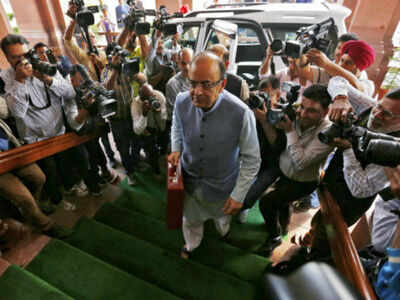
File Image
spending, not only does the government choose to influence the economy, it also rewards, punishes and promotes areas which matter politically.
When seen in this context, finance minister Arun Jaitley’s forthcoming fifth budget speech will be unique.
For the first time, the budget speech will have little space devoted to indirect taxes such as service tax and central excise. This is on account of these taxes being subsumed into goods and services tax (GST). GST rates can be changed only by the GST Council, a body which is represented by finance ministers of states and the union.
A look at recent budget speeches shows how changes in some indirect taxes were highlighted to signal something important to government. For example, Jaitley’s budget speech in 2017 was delivered in the backdrop of demonetisation and the related drive to encourage cashless transactions. This aspect was flagged in Jaitley’s speech. Of the 58-page budget speech, nine were devoted to indirect taxes. One item in indirect taxes which was flagged was the removal of customs duties in point-of- sale card reader to promote cashless transactions.
To illustrate, in Jaitley’s first budget speech in 2014, there was an indirect tax benefit granted to “sports gloves” which was flagged in the minister’s speech. In the first budget of UPA-II, finance minister Pranab Mukherjee highlighted indirect tax concessions to fuel obtained from vegetable oil. When this change is juxtaposed with subsequent budgetary measures of UPA-II, the tilt towards farmers is apparent. This important political dimension will be missing in 2018, making the budget speech unusual.
As budget speeches are always going to remain a political messaging opportunity, it is reasonable to assume that the finance minister will find ways to offset the signaling opportunity provided by the long section on indirect taxes. One of the most interesting aspects of the forthcoming budget speech, therefore, will be the analysis of methods the finance minister uses to compensate for the absence of central excise and service tax changes.
End of Article
FOLLOW US ON SOCIAL MEDIA









Photostories

Hot Picks
TOP TRENDING
Trending Stories
In Business
Entire Website
- Will banks open only for 5 days a week? Here’s what you should know about IBA’s proposal
- India set to be third largest economy, says S&P Global
- Dalal Street bull run continues! BSE Sensex crosses 69,000 for the first time; Nifty above 20,800
- Byju’s reduces notice period for employees as troubles mount
- Sensex surges over 900 points, Nifty above 20,550 as BJP state election wins bolster Modi's Lok Sabha 2024 prospects
- UltraTech to buy building materials business of Kesoram in 7,600 crore deal
- Tata Technologies stock debuts at a bumper 140% premium; share price at Rs 1200 on BSE
- Tata Technologies share allotment: How to check IPO allotment status, listing date, GMP
- BSE m-cap rides rally in Adani stocks, tops $4 trillion
- Charlie Munger, who helped Warren Buffett build Berkshire, dies at 99
- EC to announce poll dates for Maharashtra and Jharkhand today
- India-Canada diplomatic row: Trudeau's offensive pre-poll ploy amid waning support
- Will emptying the state coffers help Maha CM come back to power?
- 'Hope PM Modi will ...': What Congress said on diplomatic fallout with Canada
- SpaceX shares breathtaking videos of giant metal arms catching rocket booster mid-air
- 'Pak women cricket team played badminton like its chairperson'
- By when can Isro match SpaceX in the reusable rocket tech space?
- Wipro makes 3-days work from office mandatory: Read HR head's email
- Diplomatic row: Justin Trudeau discusses India with UK PM Keir Starmer
- Virat Kohli eager to rediscover mojo against spin bowling


Popular Categories
Hot on the Web
Top Trends
SCO Meeting Pakistan LiveCanadian DiplomatPAK vs NZ Live ScoreNigeria Football Team LibyaUGC NET ResultIsrael Hezbollah WarGautam GambhirBaba Siddique NewsRussell WilsonsBahraich ViolenceMicah ParsonsAmazon LayoffsPM Internship SchemeNEET PG Counselling ScheduleTamil Nadu Board Exam Time TableN ChandrasekaranLive Cricket Score
Trending Topics
Diwali WishesAtul ParchureSunny DeolAmitabh BachchanVettaiyan CollectionSharmila TagoreNatasa StankovicDevara CollectionBigg Boss 18Deepika PadukoneShraddha KapoorRatan Tata Passed AwayJigra Movie ReviewVettaiyan Movie ReviewSwatantrya Veer SavarkarDussehra 2024Star Health Hacker DemandedViral MemesUltimate Football Codes October 2024Wordle Answer
Living and entertainment
Latest News
Cancer, Daily Horoscope Today, October 15, 2024: Take things slowMeningitis in children: Protecting young minds through awareness and preventionHow China is lessening its reliance on helium sourced from USOdisha wins best state in 5th National Water AwardsCan a dash of cinnamon in your coffee speed up belly fat loss?'Trump doesn’t care about anyone but himself’: Supporters left stranded in 93°F heat after rallyIndia, US to ink Predator deal todayIndia eliminated from Women's T20 World Cup after NZ beat Pakistan to enter semisBrock Lesnar vs CM Punk who won the most WWE title, Single Victories, Social Media Popularities and moreThe Real World: Austin Cast Reunion After Nearly 20 Years: We 'Laughed, Cried, and Binge Watched Our Season'WWE’s Samantha Irvin Sparks Outrage with National Anthem Performance at Raiders vs. Steelers Game, Raising Eyebrows Over the Blurring Lines Between Sports and EntertainmentPannun case: Indian inquiry team to reach US on Oct 15 to probe 'foiled plot'SpaceX Marks A Spot That Isro Has Its Sights OnCongress brass obsessed with land-grab, must quit: BJPAt ‘Fama’, all faiths seek blessings of Infant Jesus15-page letter circulating online accuses IBM China head of misconduct; here's what company said while confirming the letter'Gross misuse of power': Supreme Court on SP government's land lease to Azam Khan's trust"Prayers Up!" – Aidan Hutchinson’s Mom Speaks Out After Star Player's Career-Altering Injury
Copyright © 2024 Bennett, Coleman & Co. Ltd. All rights reserved. For reprint rights: Times Syndication Service